Quick answer: A movable piece may usually promote when a move starts or ends in the opponent’s three-rank promotion zone; promotion is forced only when declining would leave no legal future move.
Best for: Beginners who know basic piece movement and want precise promotion decisions.
- In This Lesson
- Table of Contents
- 1. How Promotion Works
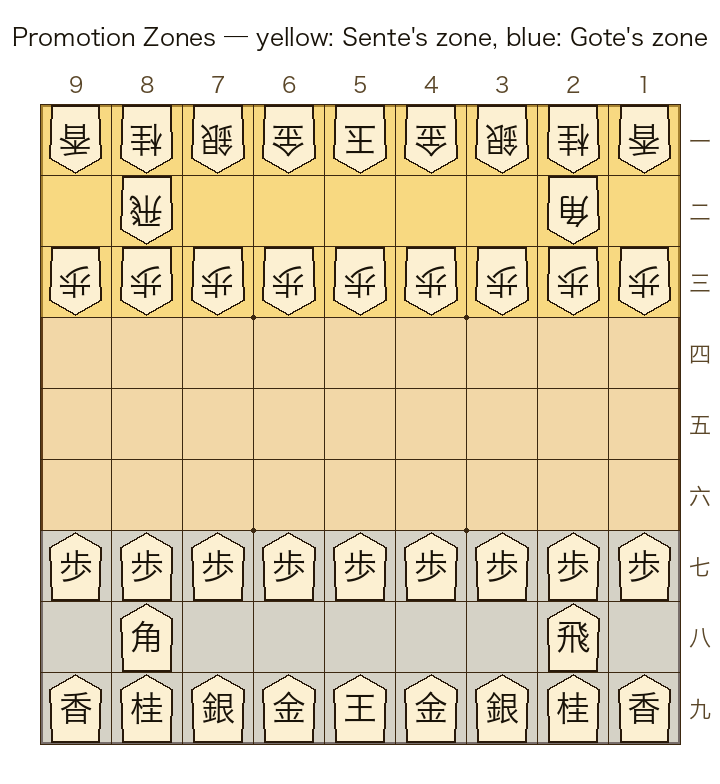
- 2. The Promotion Zone
- 3. Which Pieces Can Promote?
- 4. Promoted Piece Movements
- 5. When to Promote (and When Not To)
- 6. Forced Promotion
- 7. Drops and Promotion
- 8. Frequently Asked Questions
- Interactive Promotion
- Choose your next lesson
- Quick Check
- Related Rules
- Official Rule Source
In This Lesson
- Identify the promotion zone.
- Separate optional from forced promotion.
- Compare promoted movement.
- Avoid drop and capture misconceptions.
One of the most exciting moments in any shogi game is promotion — when a piece crosses into the opponent’s territory and transforms into a stronger version of itself. Understanding exactly which pieces can promote, how promotion works, and when to promote (or not to promote) is essential knowledge for every shogi player.
This guide covers the promotion rules, forced cases, movement changes, drops, and the positions where delaying promotion deserves consideration.
Table of Contents
- How Promotion Works
- The Promotion Zone
- Which Pieces Can Promote?
- Promoted Piece Movements
- When to Promote (and When Not To)
- Forced Promotion
- Drops and Promotion
- Frequently Asked Questions
1. How Promotion Works
When a piece moves into, within, or out of the opponent’s promotion zone, the moving player may choose to promote that piece. Promotion is indicated by flipping the piece over to reveal its promoted face — in physical shogi sets, the promoted face uses different characters and is often printed in red, although physical set designs vary.
The decision to promote is made immediately after the move. You must declare whether to promote before your opponent makes their next move. If you decline promotion, you get another opportunity only after a later qualifying move into, within, or out of the promotion zone.
Promotion is voluntary in most cases. There are exceptions (see Forced Promotion below), but generally you choose whether or not to promote each time the opportunity arises.
2. The Promotion Zone
The promotion zone consists of the opponent’s three back rows (ranks a-c for Sente; ranks g-i for Gote). Any eligible piece that:
- Moves into the promotion zone from outside it
- Moves within the promotion zone (from one promotion-zone square to another)
- Moves out of the promotion zone (from inside back to outside)
…may be promoted at the end of that move.
This is broader than chess promotion, which requires reaching the last rank. In shogi, even moving from rank d to rank c (entering the promotion zone) triggers the promotion option.
3. Which Pieces Can Promote?
Six of the eight piece types can promote. Two cannot:
- King — cannot promote; checkmating it ends the game
- Gold General — cannot promote; it has no promoted form
The six pieces that can promote are:
- Rook → Dragon King
- Bishop → Dragon Horse
- Silver General → Promoted Silver
- Knight → Promoted Knight
- Lance → Promoted Lance
- Pawn → Tokin
4. Promoted Piece Movements
Each promoted piece moves differently from its base form. Here is what each piece becomes after promotion:
Rook → Dragon King (Ryūō)
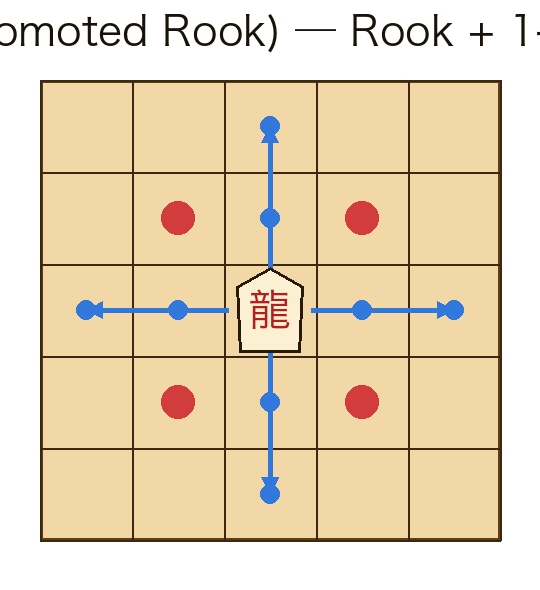
The Rook already moves any number of squares horizontally or vertically. After promotion, the Dragon King gains the additional ability to move one square diagonally in any direction. This makes it one of shogi’s most mobile attacking pieces — it combines the long-range power of the Rook with the King’s diagonal movement.
Bishop → Dragon Horse (ryuma)
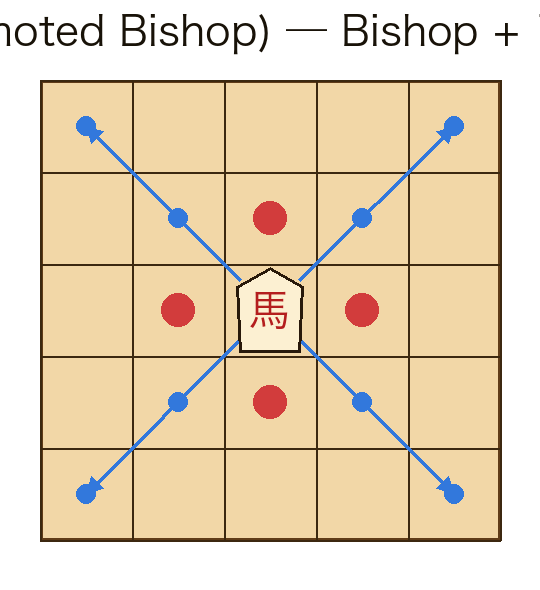
The Bishop moves any number of squares diagonally. After promotion, the Dragon Horse gains the ability to move one square horizontally or vertically. Combined with its existing diagonal range, the Dragon Horse can reach any square on the board given enough moves — making it another highly mobile major piece.
Silver General → Promoted Silver
The Silver General moves one square diagonally or one square forward. After promotion, it moves like a Gold General — one square in any direction except diagonally backward. The Promoted Silver is stronger than the base Silver in most positions.
Knight → Promoted Knight
The Knight can only jump forward in a narrow L-shape. After promotion, it moves like a Gold General — highly versatile in all directions. The Promoted Knight gains Gold movement but loses the unpromoted Knight’s jump; compare those destination squares in the current position.
Lance → Promoted Lance
The Lance can only move forward any number of squares. After promotion, it moves like a Gold General. The Promoted Lance gains backward movement for the first time, making it much more flexible.
Pawn → Tokin
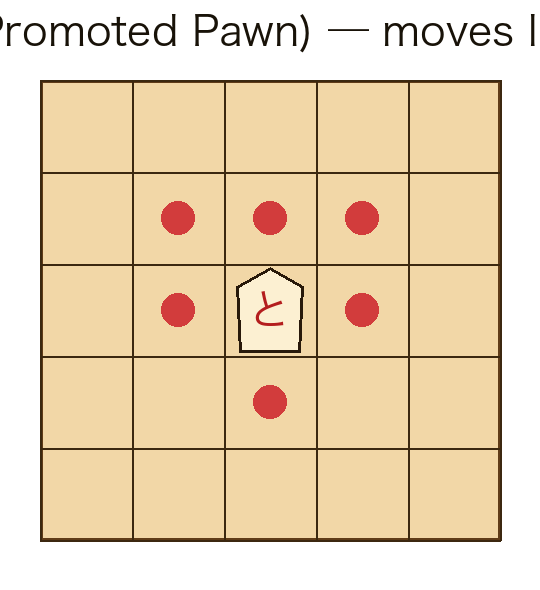
The Pawn can only move one square forward. After promotion, it becomes a Tokin , which moves like a Gold General. The Tokin is one of the most feared endgame pieces because pawns are numerous, cheap to capture, and devastating once promoted. A Tokin near the opponent’s King creates enormous attacking pressure.
5. When to Promote (and When Not To)
Promotion often improves a piece, but the decision depends on which movement pattern the next position requires.
Usually Promote:
- Rook and Bishop — promotion keeps the original long-range movement and adds one-step movement, so it is normally favorable.
- Pawn — promotion changes it to Gold movement; compare that movement with the immediate line you are calculating.
- Knight and Lance — promote when Gold movement is more useful; delay when the Knight’s jump or Lance’s long forward range is still central to the tactic.
Sometimes Do NOT Promote (Silver):
The Silver General is the most interesting promotion decision. The Silver can move diagonally, including backward diagonally — something the Gold General (and therefore the Promoted Silver) cannot do. In certain attacking positions, the Silver’s unique diagonal retreat allows for specific tactical maneuvers that the Promoted Silver cannot perform.
The rule of thumb: if you need the Silver for attacking (especially for piece sacrifices and diagonal maneuvers), keep it unpromoted. If you need it for endgame purposes, promote it.
Strategic Promotion Timing:
- Promote immediately when the promoted form is clearly more useful right now
- Delay promotion if the piece is in a position where its base movement is specifically needed for the next few moves
- Consider promoting mid-attack — some attacking sequences use an unpromoted piece to initiate an exchange, then promote the piece that results from the trade
6. Forced Promotion
In certain situations, promotion is mandatory because leaving the piece unpromoted would trap it permanently — it would have no legal move on any future turn:
- A Pawn or Lance on the opponent’s last rank (rank a for Sente; rank i for Gote) must promote — a Pawn or Lance on the last rank can never move again if unpromoted
- A Knight on either of the opponent’s two back ranks (ranks a or b for Sente; ranks h or i for Gote) must promote — it has no legal forward L-shape jump available from those ranks
In all other situations, promotion is a choice. But when forced promotion applies, the piece must be promoted on that move — you cannot place a Pawn on the last rank and leave it unpromoted.
7. Drops and Promotion
Captured pieces — those in your piece reserve — always enter the board in their base (unpromoted) form, even if they were captured while promoted. A Dragon King you capture enters your hand as a Rook. You can drop it on a legal empty square. It remains unpromoted until a later move starts or ends in the promotion zone and promotion is chosen or required.
After a promoted major piece is captured, the captor receives the unpromoted Rook or Bishop in hand. Evaluate the exchange from the resulting position: material in hand, King safety, legal drops, and whose move it is.
8. Frequently Asked Questions
Can I choose not to promote and promote on a later turn?
Yes, as long as the piece makes another move into, within, or out of the promotion zone. Choosing not to promote does not lock you out permanently — it just means you need to move through the zone again to get another opportunity.
If my promoted piece is captured, does my opponent get a promoted piece?
No. All captured pieces revert to their base form and enter the captor’s piece reserve unpromoted. A Dragon King becomes a Rook when captured. A Tokin becomes a Pawn.
Can I promote a piece that was just dropped?
No. Dropped pieces cannot be promoted on the turn they are dropped, even if they are dropped into the promotion zone. They must make a separate move from within the promotion zone to earn promotion.
Is it bad strategy to avoid promoting your pieces?
Usually, but not automatically. Rook, Bishop, and Pawn promotion adds useful movement without removing their base reach. Silver, Knight, and Lance change movement patterns, so compare the squares you gain with the ones you lose before deciding.
Interactive Promotion
Quick Check
When must Sente promote a Knight?
A Sente Knight on rank a or b would have no legal unpromoted jump, so promotion is mandatory there.
Related Rules
A captured promoted piece returns to its unpromoted form in hand. Review piece drops and nifu to see how that reset affects later play.
Official Rule Source
Promotion-zone eligibility, forced promotion, captured-piece reversion, and drops are checked against the current Japan Shogi Association playing rules. Strategic recommendations remain conditional on the displayed position.
Content review: coordinate terminology and optional and mandatory cases rechecked August 2, 2026.