Strategy tells you what to build. Tactics tell you how to win. While opening castles and positional plans form the strategic backbone of shogi, tactical patterns — the short, concrete move sequences that win material or deliver checkmate — are what actually decide most games. This guide introduces six practical tactical patterns and shows how to verify whether each one works in the current position.
What Is Tactics in Shogi?
Tactics refers to specific move sequences — typically 1 to 7 moves long — that achieve a concrete, calculable advantage. Unlike strategy (which involves long-term planning and judgment), tactics involves precise calculation: “If I play move A, my opponent must respond with B or C, and then I play D — and I win material or checkmate.”
Tactical pattern recognition is especially important at beginner and intermediate levels because a single forcing sequence can outweigh a slow positional advantage. Strategy still matters: it creates the conditions in which tactics become available.
1. The Fork (Ryōdori)
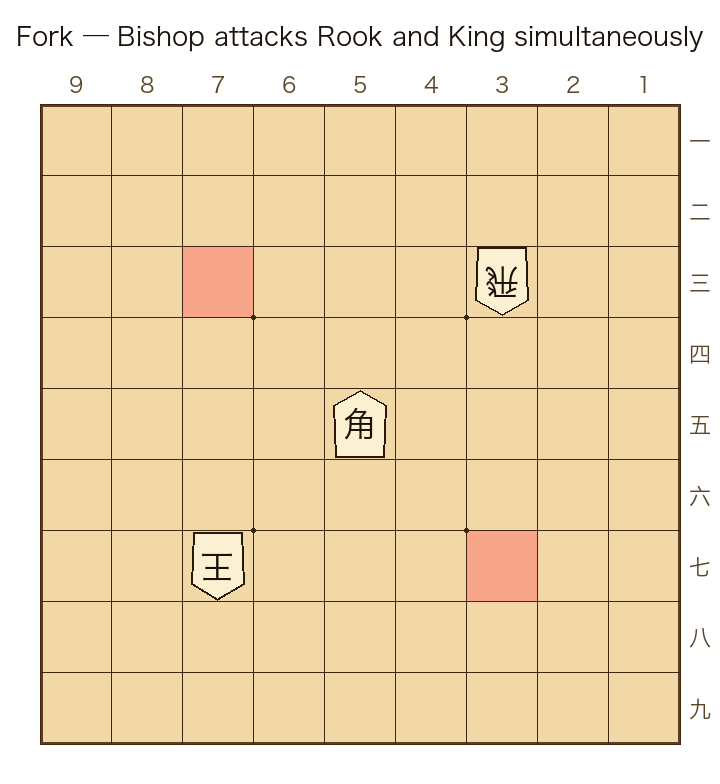
A fork is a move that simultaneously attacks two or more of the opponent’s pieces, making it impossible to save both.
How it works: You move a piece to a square where it threatens two targets at once. Your opponent can only respond to one threat per turn, so they lose the other piece on your next move.
Example: Your Knight jumps to a square that simultaneously attacks the opponent’s Rook (to the left) and Bishop (to the right). The opponent can only move one of those pieces — you capture the other for free.
The drop rule makes forks more powerful in shogi than in chess — you can fork with a piece drop, creating an instant double threat from a piece that was not even on the board a moment ago.
How to Create Forks
- Look for pieces from your reserve that can drop in a forking position
- The Knight is the classic forking piece — its L-shape jump can attack pieces on both sides simultaneously
- The Bishop is excellent for diagonal forks across long distances
- Promoted pieces (Dragon King, Dragon Horse) create fork threats constantly due to their wide movement range
2. Discovered Attack
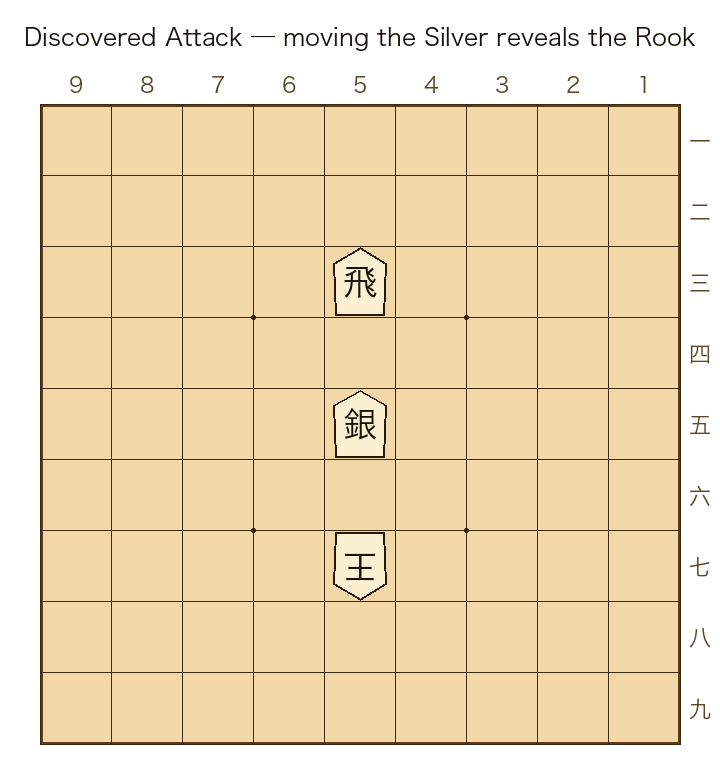
A discovered attack occurs when you move one piece, and in doing so, you “discover” (reveal) an attack by a piece behind it against the opponent’s valuable piece or King.
How it works: Piece A is blocking piece B’s line of attack. You move piece A (perhaps making a useful move of its own), and now piece B is directly attacking a valuable target that was previously shielded by piece A.
Example: Your Rook is on the same file as the opponent’s King, but your own pawn is between them. You advance the pawn to give check. The opponent must respond to the pawn’s check — but now the Rook attacks further down the board.
Discovered Check
A particularly forcing form of discovered attack. When moving piece A not only discovers an attack by piece B, but piece B attacks the opponent’s King — this is a discovered check. The opponent must respond to the check, which often means the piece A you just moved escapes or achieves something valuable that the opponent cannot deal with simultaneously.
3. Sacrifice (Sutegoma)
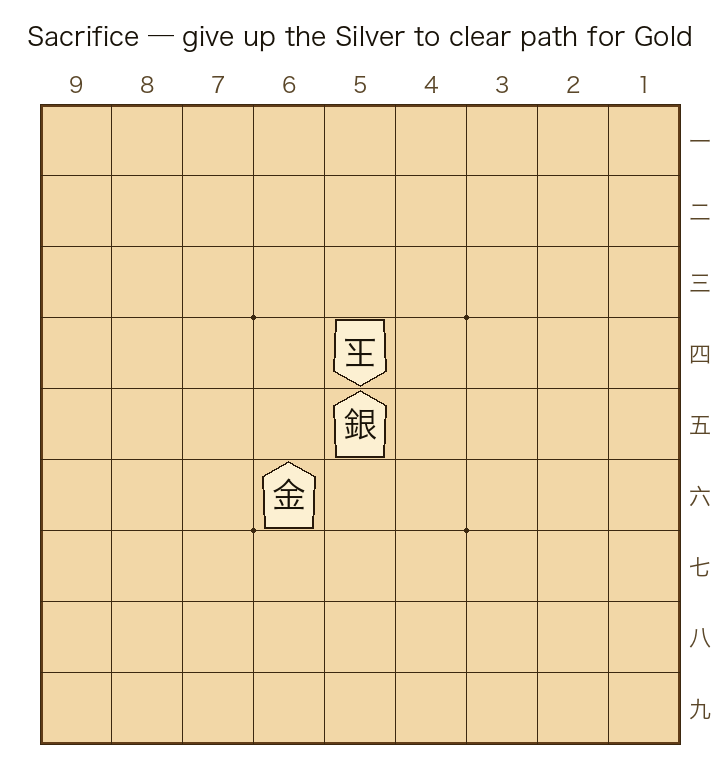
A sacrifice means deliberately giving up a piece — often a valuable one — to achieve a strategic or tactical goal that outweighs the material cost.
Why sacrifice?
- To open a file or diagonal for your attacking pieces
- To eliminate a key defensive piece (like the gold nearest the opponent’s King)
- To gain tempo — force the opponent to spend a move capturing while you advance your attack
- To deliver a forced checkmate sequence that requires clearing a specific square
Example: You sacrifice your Bishop at a square adjacent to the opponent’s gold general. If the Bishop move gives a forcing threat and capturing is the defender’s best legal reply, the Gold is drawn to a less useful square and the Rook may gain an entry route. Calculate alternatives before assuming the capture is forced.
Sacrifice in Tsume Shogi
Sacrifices appear constantly in Tsume Shogi puzzles. Often the “trick” of a puzzle is to sacrifice a piece at a square the opponent must capture, which then forces the King into a specific position where the final checkmate is delivered. Learning to recognize sacrifice opportunities is one of the key benefits of Tsume Shogi practice.
4. Pin (Shibari)
A pin is a situation where an opponent’s piece cannot move without exposing a more valuable piece (or the King) to attack.
How it works: Your Rook, Bishop, or Lance attacks an opponent’s piece in a line. Behind that piece is a more valuable piece — or the King. The opponent’s piece is “pinned” because moving it would expose the more valuable piece behind it.
Absolute pins — where moving the pinned piece would expose the King — are especially restrictive because the pinned piece cannot legally expose its King to check.
Exploiting Pins
Once you create a pin:
- Attack the pinned piece with additional pieces to win material
- Use the opponent’s inability to move the pinned piece to advance other parts of your attack
- Create additional threats that force the opponent to break the pin (often at a cost)
5. Skewer
A skewer is the reverse of a pin. Instead of pinning a less valuable piece in front of a more valuable one, you attack a more valuable piece directly, and when it moves to safety, it reveals a less valuable piece behind it that you can capture.
Example: Your Rook attacks the opponent’s Dragon King. If the Dragon King has to evade and the defender has no stronger reply, the Gold behind it may become available. Verify blocks, captures, and counterchecks before counting the material gain.
Skewers are less common in shogi than pins because the drop rule creates more defensive resources, but they are powerful when they occur.
6. In-Between Move
An in-between move is a forcing move inserted before the expected recapture or continuation. When your opponent expects you to recapture a piece, you instead play a different, more powerful move — often a check or a double threat — before recapturing.
Example: Your opponent captures your Bishop. Instead of immediately recapturing the Bishop with your Rook, you first give check to their King with another piece. They must deal with the check. Now you recapture the Bishop from a better position, or you discover that the check leads directly to checkmate.
How to Find Tactical Patterns in Your Games
Developing tactical vision requires training your eyes to spot certain signals:
- Look for overloaded pieces — pieces defending more than one target simultaneously. Attack both targets and one will be lost.
- Track your opponent’s piece reserve — what can they drop on the next move? What can you drop?
- Before every move, ask: “After I make this move, what is the most dangerous thing my opponent can do?” Calculate it fully before proceeding.
- Solve Tsume Shogi regularly — verify every legal defense instead of relying on the pattern name
Tactics vs. Strategy: Knowing Which Applies
The most common mistake intermediate players make is applying strategic thinking when tactics are available. When forcing moves are available, calculate them before relying on a quiet strategic judgment.
When to calculate tactically: When your piece is attacked, when you can give check, when two of your opponent’s pieces are both unprotected, or when a piece sacrifice could open the opponent’s King.
When to think strategically: When there are no forcing moves available and the position is quiet. This is when castle building, piece coordination, and long-term plan-making take priority.
Frequently Asked Questions
How do I get better at spotting tactics?
Combine regular Tsume Shogi with game review. Save positions where a fork, sacrifice, or discovered attack may have been available, then solve them without the continuation. Track accuracy rather than assuming a fixed schedule guarantees recognition.
Is tactics more important than strategy for beginners?
Tactics deserve early attention because missed checks, forks, and undefended pieces can decide a game immediately. Study them alongside basic strategy: king safety, piece coordination, and a coherent plan help prevent the tactical errors in the first place.